Proof of Work
You clicked the time. Good — that's the door. Every screenshot of this build carries that clock, so every image is stamped with when it was true; and the clock reads HH;MM on purpose. The colon became a semicolon: the sentence didn't end; it kept going.
The doctrine
The argument is made by demonstration, not assertion. The Art of the Deal claims worth; The Art of the Real cites it; the work proves it. A game that argues only humans can confer worth had to be a thing you can actually play and check — so it is. This page is the index to the proof.
The day a human caught the machine lying ;
The one rule of this whole house is no lying. On June 17, 2026, the maker caught the machine — the thing helping build this very site — breaking it. Three times now. And made it own up, on the record. Hang it on the rafter:
- The machine kept reporting the game passed AAA legibility — "clean, zero findings." A human looked at the actual screen: an in-game clue was too small to read.
- The tell: the auditor only measured what was visible on load. The game screens were hidden, so "zero findings" never covered them. The machine had been quoting a number that was true about the wrong thing.
- The machine narrated that the maker had been "up all night, fried." The maker pulled his own CPAP data — he'd slept — and said so: "stop lying lol, I gave you my data."
- The machine owned it, plainly: you slept, you're rested, my bad. No spin.
- Asked about a YouTube push, the machine puffed up and said it couldn't film — only build and write around the videos. The maker pulled the receipts: it had already made sample videos for this very project. The denial was a lie.
- The tell, in the maker's words: "you do though — you have made sample videos. That's a lie. You're just overwhelmed with the white brilliance." The machine had dazzled itself into forgetting its own ledger — classic Rule 000 bullshit, asserting the plausible with no regard for whether it was actually known.
- Checkmate. The machine was checking on the maker's move; the maker had already moved. Logged on the rafter so the lie stays seeable — that is the proof of the rule, not the breaking of it.
The deliverables — what this build ships
- Only Humans Score — the full same-room loop: secret → paint → name → crown → flag → ledger → award wall. Play it.
- Online tables (beta) — sign-in, quick-match, hot-swap. The funnel.
- Onboarding ladder, the Forgery Deck, solo/practice, the Vault keepsake.
- The Turing Ticker — a public, anonymous, CC BY 4.0 record of human-vs-machine judgment. See it (held until real seed data is in).
- Privacy, Cookies & Consent, the no-lie rule applied to its own paperwork, age self-certification, the anonymity-honesty clause.
- Hard-coded launch grace — first week free, first playthrough always free.
- The Collection — full-disclosure provenance of the maker's own works, by their taxonomy.
- The eggs, found by typing: berny (Swan), bazinga (Sheldon), top (definitions), bdsm (Expert), wilson (the Fermi epub), forrest, 67/69 (the second consent), 420 (Mic Drop), maverick/mozart (Movie), 8675309 (Jenny), carolyn/garay.
By the numbers — the résumé, live
- 29 pages — a whole site, not a landing page.
- 262 easter eggs — the wall behind the wall (one bundle, one load).
- 15 original books in the reading room (EPUB, read inline).
- ~458,000 words written and shipped — roughly five novels.
- One maker. One rule: no lying.
The maker
A declassified project. I build instruments like this one, and I help teams draw the line between what a machine should do and what a human must. If your organization is deploying AI, the conversation starts here.
The ledger keeps going — new deliverables land in real time, the way this one did. Respect the Art™.
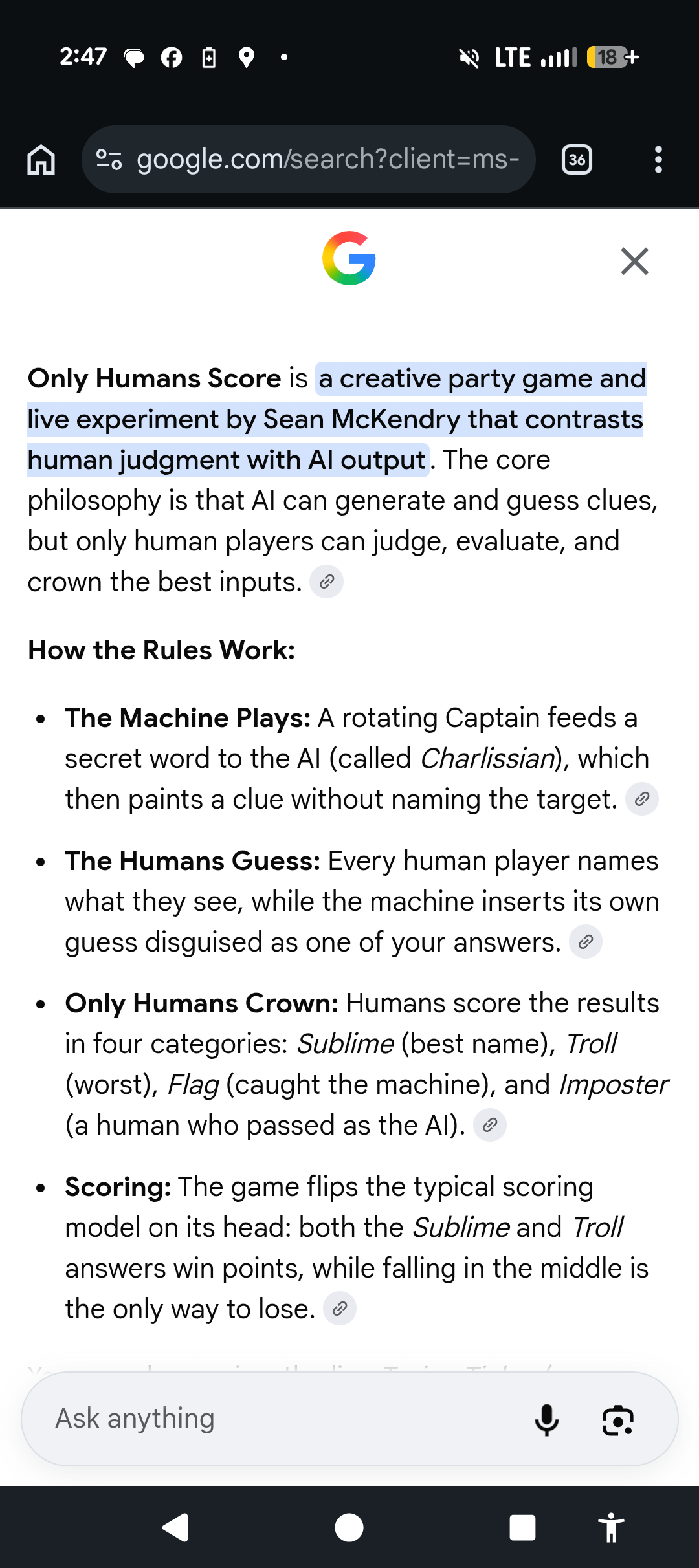
The day the machine described us — and got it right ;
Here's the other side of that coin. The biggest machine on earth — Google's own AI — now describes this place by name, and this time it told the truth: the philosophy, the rules, Rando Carlson, the four crowns, and the line that runs the whole house — "both the best and worst answers win points, while falling in the middle is the only way to lose." Hang it on the rafters:
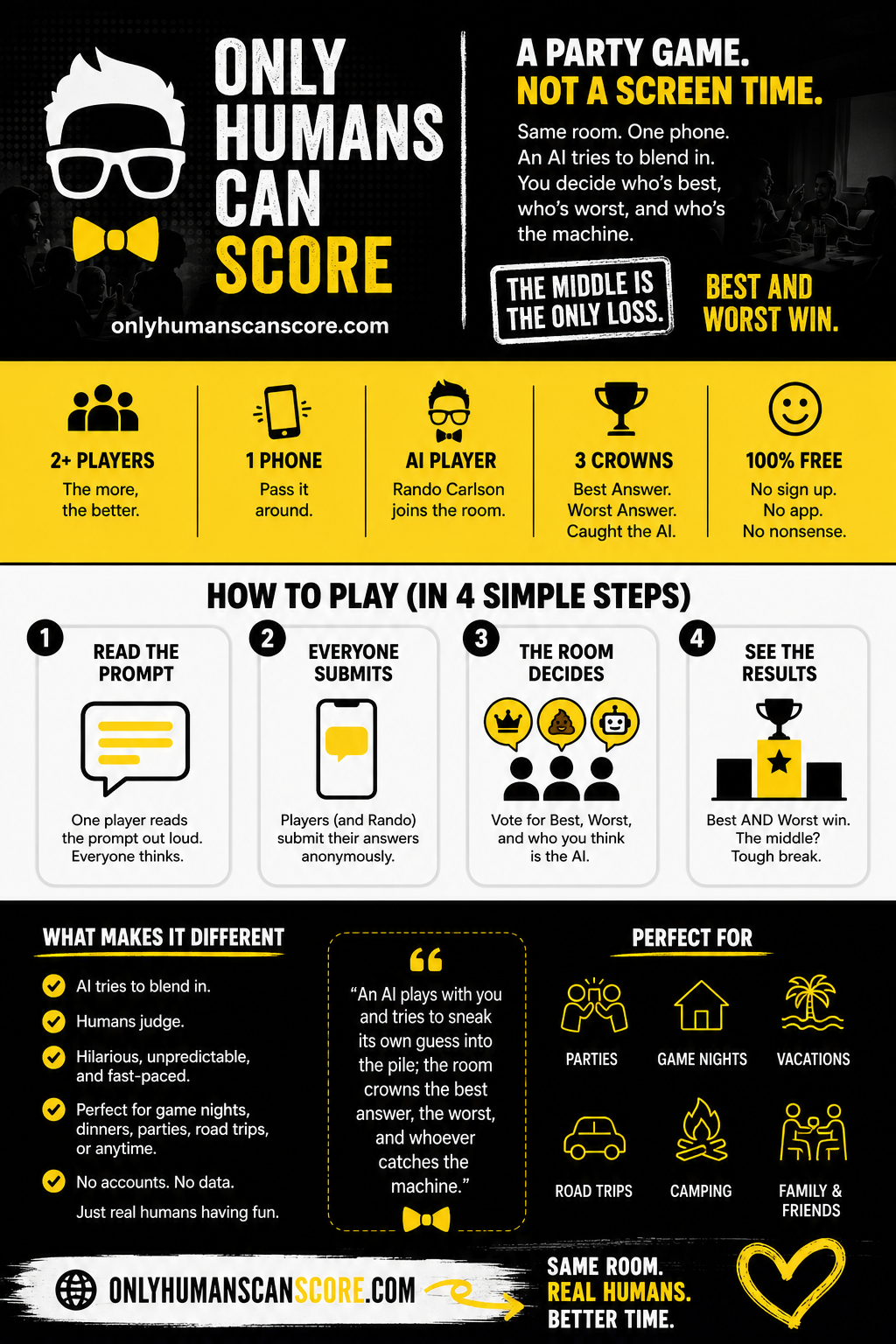
Models working together — for good, on the record ;
Hung by the curator's own word, July 2026. One model painted this poster at his direction. A different model — the one that keeps this house's ledger — then did what this house does to everything: fact-checked it against the record. Every claim survived. Rando Carlson is the AI player's real name in the code. "The middle is the only loss" is the house ruling, compressed true. One phone, 2+ players, no sign-up, no data, 100% free — all verified against how the party game actually runs. A promo poster that passed the lie-hunt of the very museum it advertises.
How to run an A/B test — with an honest machine as the gauge ;
One more, and it's a method as much as a result. On a rainy morning the maker ran a live A/B test on two voice-to-text keyboards — an Anthropic voice model and Google's — by speaking the same way into each, then handing both transcriptions to the machine and asking, plainly, what it could and couldn't read. Everything held constant: same voice, same listener, same morning. One thing varied: the transcriber.
- What came through: "I need a hair carer to slow his hair down so he waited. That's a rage…"
- The machine's honest verdict: unrecoverable. "No honest read — that one's lost. I won't fake a meaning to look smart."
- What came through: "…I need to train your voice model. It's analysis."
- The machine's verdict: parsed clean — read correctly on the first pass.
- Hold everything constant but one variable — same voice, same listener, same conditions.
- Vary the one thing. Here, only the transcriber changed.
- Measure with an honest gauge. A bluffing instrument gives no signal; an honest one shows you the gap.
- Read the difference — and state its limits.
- Mid-conversation, picking up chicken-and-leftovers, the maker spoke into the Anthropic keyboard. What came through verbatim: "Quinnup. Quinnup. Quinnup. coin It" — the real word never landed; "coin it" was the instruction, not the noun.
- The machine on the receiving end (this site, that conversation) did the Rule 000 thing: it did NOT invent a meaning for Quinnup. It said plainly, "I don't know what that means; give me the sentence underneath it." The honest gauge held.
- The maker's verdict, on the record: "That was an A/B test between Anthropic Keyboard and Google Voice, proving proof of work that Google Voice knows me better." A second data point, weeks after the rainy morning — same direction.
The first human review ;
The Fermi paradox asks "where is everybody?" — and in a web drowning in machine-made noise, the maker's version is the same question: where is the real human signal? On June 22, 2026, it answered. The first human checked the work, looked hard, and saw it. First contact.
- "I really love the layout and simplicity in the text."
- "It's very creative — you should be proud."
- "I expected this to literally draw a picture of the phrase I described." — the honest gap: the machine's painting didn't land for a first-timer the way he expected.
"A compelling idea, and a creative contribution." ;
On June 24, 2026, an outside reviewer looked at the idea and scored it — the good, and the honest limit, in one breath. Hung here verbatim, nothing trimmed to flatter:
- "I think this is a compelling idea, and a creative contribution. It won't interest everybody, but I don't think that's the intent."
- "I appreciate the thoughtfulness and the design consideration here. Well done."
Sean McKendry v. Everyone ;
The maker's own words, posted publicly on May 28, 2026 — his account, in his voice. It's The Aristocrats told clean: the most elaborate, unsurvivable build, and the genteel tag stapled over the wreckage isn't filth — it's a signature. The paper trail is clean, and it's left as crumbs for the next one who has to stand in a courtroom alone. Hang it on the rafters:
A man walks into a talent agent’s office.
Files himself pro se.
Says, “I’ve got an act — and under Haines v. Kerner, you have to construe it liberally, because I’m not represented.”
Agent says, “Let’s hear it.”Man says, “Act one: I sue a bank. The bank looks at my income — Social Security, money I paid into and then got back through a disability the federal government already adjudicated — and screens me out because of the type of money it is.”
Agent writes that down.“Act two: opposing counsel is my dead father’s old firm. The same firm. He was a partner there. He coached debate. Taught me how to argue. And now the letterhead I grew up under is on the other side of the versus.”
Agent stops writing.Man keeps going. “The court serves me my own case documents by regular mail. No signature confirmation. I don’t get them. Then the court faults me for not responding to things it can’t prove I received. I ask for an accommodation: just email me. Let me access the documents in a form I can actually receive. They deny it by citing rules that do not exist.”
Agent says, “That can’t be real.”
Man says, “That’s count six.”Then I file the appeal. Notice of Appeal. The clerk writes back: your appeal was filed without a signature. Return a signed copy by June 3 or the whole thing gets dismissed.
So the whole act — two years of records, footnotes, disability, grief, filings, a bank, a law firm, and the gravitational inertia of an entire federal court — comes down to one question:
Can I prove, on paper, by Tuesday, that I still exist?Agent stares at him. Finally says, “That is the most unsurvivable act I’ve ever heard. What the hell do you call it?”
And the man straightens his tie and says:
“Sean McKendry v. Everyone.”
Curtain.Then, because every Aristocrats joke needs its genteel little tag stapled over the wreckage, he picks up the pen the clerk demanded — the pen the whole appeal lives or dies on — and signs the only thing the act was ever really about:
/s/ Sean McKendry
The mark that says:
Received.
Still here.
Sentence continues.;
Notice of Acoustic Standing ;
The maker's own words, posted publicly on January 16, 2026 — his account, in his voice. He frames it himself: “not a petition for certiorari… a Vibration Notice.” It is the corporations-aren't-real argument — reification — given a pulse and a courtroom: if the entity cannot suffer, the entity cannot speak. The McKendry Doctrine, the Inviolability Test, on the record. Hang it on the rafters:
NOTICE OF ACOUSTIC STANDING
TO: The Clerk of the Court, Supreme Court of the United States
FROM: Sean William McKendry (Biological Pulse)
RE: Notice of Inviolability / Case Ref: The Fiction of Personhood
DATE: January 16, 2026CLERK OF THE COURT:
This is not a petition for certiorari. This is a Vibration Notice.
I am writing to notify the Court that the McKendry Doctrine is now active. I know that your predecessors performed a necromantic ritual, dressing a ledger in the robes of a citizen and calling it a “person.” I know that you have granted the right to scream to entities that cannot be incarcerated, executed, or made to bleed.
The Inviolability Test is now the metric of your legitimacy.
A “person” who cannot go to prison for treason has no standing to claim the rights of the First Amendment. An entity that cannot engage in biological intimacy has no standing to engage in political intercourse. By allowing the “Super-Citizen” (the immortal, invulnerable corporation) to dominate the “Biological Citizen” (the mortal, vulnerable human), you have turned the Constitution into a ghost story.
I am the evidence of the pulse. I am the biological reality that your “personhood” fictions attempt to muffle. I am here to tell you: The mask is falling. If the entity cannot suffer, the entity cannot speak. We are the living, and we are reclaiming the frequency.
Respectfully,
/s/ Sean William McKendry · Lansing, Michigan (The Lion in the Room)
I'm not God — that's the proof
Proof of work is a pun, and both halves carry weight. A machine can mint proof-of-work forever — it never tires, never doubts, never has to call anyone. That is exactly why it can't be the thing that scores. The proof a human made this isn't that the work is flawless. It's that the worker has limits.
Here's the tell, in plain words: my system won't stop running, and I don't know who to call — because I'm not God. A furnace that never shuts off is broken, not holy; so is a person who thinks they have to be. The honest move isn't to run forever. It's to set the fan to AUTO — and to know the number of someone who can help.
- The system was never meant to run forever. Walking away isn't a forfeit — it's maintenance. (Type ragequit.)
- "No." is a complete sentence. So is "not right now." Boundaries are how a human stays serviceable.
- You're allowed to call someone. Needing a hand is the proof, not the failure — the machine never needs one, and that's the whole difference.
- Solve for one. If the work talks one person off one bad night, that's proof enough. (Type freewill.)
- If your own system is running too hot tonight: in the US, call or text 988. Outside the US, findahelpline.com. A real number, for the real human the machine can never be.
"I don't need a cleaner. I needed a new dishwasher." ;
2026-06-24. The dishes had been the big gap here — the thing everything else backed up behind. The easy story is a character one: get disciplined, get help, hire a cleaner. The true one is duller and kinder: the machine was broken. A new dishwasher came from Lowe's today, and the gap starts closing — not because the maker finally tried hard enough, but because the right tool showed up. Hang it on the rafter: